ABOSS review: booking agency software priced per artist, with unlimited users
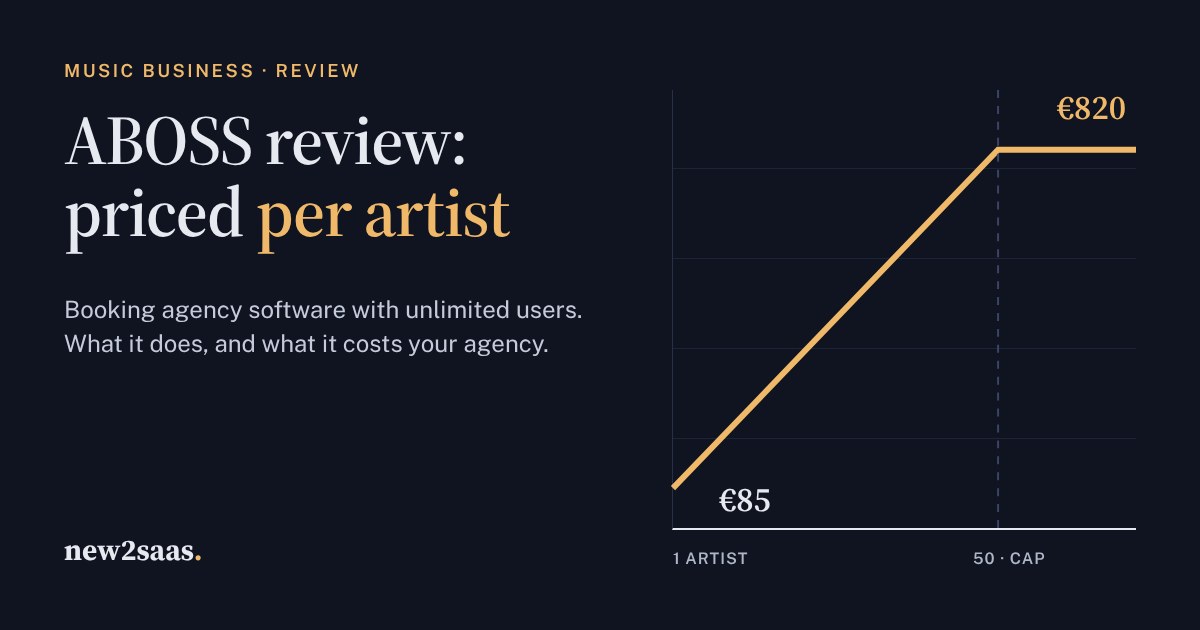
ABOSS is Amsterdam-made booking agency software for calendars, deals, contracts, invoices and advancing, with a free app for artists and crew. Its pricing is unusual: unlimited users, and you pay €70 a month plus €15 per active artist, with the price capped at 50 artists.
This review covers every module, the five deal types, Artist PRO, the mobile app and the API. It also covers what costs extra and who ABOSS suits. Two interactives show how common deal types pay out and what ABOSS would cost your agency.
What ABOSS is
ABOSS is back-office software for the live music business. It calls itself "the operating system for live music". It gives a booking agency one place for its artists' calendars, the deal behind every show, the contract, the invoice, and the travel and production details that crews need on the road. Artists and their crews see the same data in a free mobile app.
The company is from Amsterdam. It was founded in 2014 by Arvid Silos and Thomas van Beek, raised a small seed round from the Dutch investor Keadyn in 2016, and today describes itself on LinkedIn as a team of 2–10 people. Its homepage invites you to "join 20.000+ artists and crew members" and shows logos of companies such as Live Nation, Warner Music Live and Goodlive Artists. The page doesn't say how they use ABOSS.
There are four products, and it helps to keep them apart:
- ABOSS Agency: the booking agency software. Most of this review is about it.
- ABOSS Artist PRO: the same back office for an artist or their manager, linked to one or more agencies.
- ABOSS Mobile: the iOS and Android app for artists and crew, free, with a paid "Plus" tier.
- The ABOSS API and SAPPS: a public API (in beta) and a small marketplace of add-on apps.
How ABOSS Agency works
Everything hangs off a project. ABOSS defines a project as an artist's environment with its own calendar, shows, deals, contracts and travel. That is usually one artist, sometimes a band or a side project. Older accounts called these "calendars". The project is also the unit you pay for, which matters below.
Calendar and availability
Each artist's calendar holds shows, options and non-show items (blocks, travel days, promo), with drag-and-drop, duplicate events and reminders. ABOSS warns about conflicts and double bookings, and it has region protection, so an agent doesn't book an artist into a territory another show has exclusivity on. Calendars can be shared with artists, managers and other agencies, with permissions per person.
Deals: where ABOSS is strongest
The deal module is the heart of the product. ABOSS supports five deal types: flat fee, guarantee, guarantee +, guarantee vs. and door deal. You can add bonuses triggered by tickets sold, ticket revenue or occupancy. It calculates booking fees (a percentage or a fixed amount), management commission, withholding tax, costs and the break-even point, then turns all of that into artist statements and VAT invoices. If your agency books shows where the fee depends on ticket sales, this is the part you will use every day. The explainer below shows what the deal types mean in euros.
Contracts and digital signatures
Contracts and invoices are generated from templates filled with the deal data. ABOSS offers ISO-certified digital signatures. Each plan includes a number of free signature requests a month, and extra requests cost €0.75 each, according to ABOSS's help center. That is cheap per contract, but it is not unlimited. SystemOne, a competitor, makes a point of including signing in its price; more on that in our ABOSS vs SystemOne comparison.
Invoices, VAT and Peppol
Invoicing covers multiple administrations (entities), numbering groups, credit invoices, partial payments, locked invoices and EU VAT number checks through VIES. For agencies that must send Peppol e-invoices (compulsory since 1 January 2026 for invoices between VAT-registered businesses in Belgium), ABOSS connects to the Peppol network through Billit, a third-party access point that you set up and connect yourself. Agencies outside Belgium can ignore this for now; Belgian agencies should look at it closely.
Advancing, travel and the mobile app
Production and logistics details, flights (looked up by flight number), hotels, ground transport, guest lists and PDF itineraries all live with the show. Promoters can fill in advancing through an external link. Artists and crew get it all in ABOSS Mobile for iOS and Android: the calendar, show details, itineraries, contacts and files, available offline and synced with the agency's account. It is free. Mobile Plus costs €11.99 a month per user and adds AI daily digests, a chat interface to your data, revenue projections and live flight tracking.
Statistics and the API
The dashboard breaks results down by artist, agent, country, period and status, with gross fees, booking fees, agency and artist profit and average fees. For anything beyond that, ABOSS has a public REST API with OAuth 2.0. It is in public beta, with nine read endpoints (events, deals, contracts, invoices, contacts, locations, projects, advancing and travel). ABOSS says it charges no per-request fees. Three desktop add-ons built on it, Planboss, Dashboss and Portboss, add roster planning, dashboards and Excel exports. The API is read-only today, so it is good for reporting and websites, less so for pushing data in.
ABOSS pricing, explained
ABOSS Agency has one plan with every module included and unlimited users. You pay:
- a base fee of €70 a month (about €56 a month on a yearly plan);
- plus €15 per active project a month (€12 on a yearly plan).
Three rules make the bill smaller than it first looks:
- The price stops rising at 50 projects. Projects above 50 are free, so the most a monthly plan can cost is €820 a month.
- Only active projects count. Archive an artist you no longer book and, on a monthly plan, billing for it stops straight away.
- Artists on Artist PRO are free to the agency. When an artist upgrades to their own Artist PRO account, the agency stops paying the €15 for that project, and so does every other agency connected to that artist.
A yearly plan saves 20%, but you commit to a minimum number of projects. You can add projects during the year (extras are billed at €15 a month), but you can't go below the committed number until renewal. Agencies get no free trial; ABOSS suggests starting monthly with one or two projects instead. A 30-minute live team training and hands-on onboarding are included. A full data import and extra training sessions cost extra.
For comparison, SystemOne charges per agent instead (€80 a month plus €42 per agent, with unlimited artists). An agency with many artists and few agents can pay less there; an agency with many agents and a small roster usually pays less at ABOSS. Our ABOSS vs SystemOne page maps exactly where the line falls, and ABOSS alternatives compares six tools side by side.
ABOSS Artist PRO
Artist PRO is ABOSS for the artist's side: the artist, their manager, or a small team that runs its own back office. It costs €49 a month or €528 a year. The trial is 14 days if you start from the website, or 30 days if an agency on ABOSS invites you. Its main idea is that the artist owns their data and connects to one agency per territory, seeing each deal as the agency builds it. It produces automated artist statements and coordinates crew and travel.
Artist PRO makes most sense for artists who already work with an agency on ABOSS. It also changes the agency's maths: every artist who upgrades takes €15 a month off the agency's bill, which covers almost a third of the artist's own subscription. For an artist with no agency, it is a lot of booking machinery for one calendar; a lighter tool may fit better.
Strengths and weak spots
What ABOSS does well
- Unlimited users. Interns, accountants and every agent get a login at no extra cost. Most rivals charge per agent.
- Deep deal maths. Five deal types, ticket-based bonuses, withholding tax and break-even points, flowing into statements and invoices.
- A connected network. Agencies, artists on Artist PRO and crews share one calendar. That is useful when an artist works with different agencies per territory.
- A clear price ceiling. The bill stops rising at 50 projects, and archiving an artist stops billing on monthly plans.
- A free app that works offline, for the people on the road.
What to check before you sign
- Large rosters with few agents. Per-artist pricing adds up: 30 artists cost €520 a month on monthly billing, and SystemOne charges €206 a month for three agents with unlimited artists.
- Signatures and Peppol cost extra. Signature requests beyond the free allowance are €0.75 each, and Peppol needs a separate Billit account.
- Language and customisation. SystemOne's comparison page describes ABOSS as English-only, with limited template styling and no custom fields. ABOSS's own pages don't list interface languages, so ask in the demo if your team needs Dutch, German or Spanish.
- No agency trial. You learn by paying for a month with a project or two, or by booking a 20-minute demo.
- Few public reviews. At the time of writing, ABOSS had no user reviews on Capterra, so there is little independent feedback to read. Ask ABOSS for references at agencies your size.
- The API is read-only and in beta. Fine for dashboards and websites, not yet for two-way syncs.
Who ABOSS is for
ABOSS fits agencies that book ticket-dependent shows, have several people who need access, and work with artists who are connected to more than one agency.
A good fit: small and mid-sized booking agencies (roughly 5–50 artists) with several agents or assistants; electronic and touring agencies that use guarantee-plus and versus deals; agencies whose artists work with different agencies in different territories.
Look further if: you are one or two agents with a very large roster (per-agent pricing will likely be cheaper), you need a fully translated interface or heavily customised Word contract templates, or you are a venue or promoter buying shows, where a buyer-side tool like Prism.fm is built for the job.
If ABOSS sounds right, the cheapest way to find out is a monthly plan with one or two artists. You can start from ABOSS's pricing page (a referral link: ABOSS may reward us if you sign up, and your price is the same), or book their free demo first.
What to look for in booking agency software
- Count both agents and artists before comparing prices. Per-artist and per-agent pricing favour opposite kinds of agency.
- Price the extras: e-signatures, Peppol e-invoicing, data import and training.
- Test your real deal types in a demo, including bonuses and withholding tax, not just a flat fee.
- Check what artists and crew get for free. They will use the app more than anyone in the office.
- Ask about exporting your data before you import it.
Sources
- ABOSS: homepage and products
- ABOSS: agency pricing and FAQ
- ABOSS: agency features
- ABOSS: Artist PRO pricing
- ABOSS: Mobile and Mobile Plus
- ABOSS: API and developer platform
- ABOSS help center: deal structure and deal types
- ABOSS help center: digital signature billing
- ABOSS help center: electronic invoicing and Peppol via Billit
- FPS Finance Belgium: structured e-invoicing
- The Next Web (2018): ABOSS founders and background
- SystemOne: SystemOne vs ABOSS (a competitor's own comparison)
- SystemOne: pricing
- Capterra: ABOSS listing